
Hair Extensions in Chennai for Men & Women
DA Extensionzz fits hair extensions at three studios in Chennai — T. Nagar, Nungambakkam and Thousand Lights. Five professional methods, all in 100% human hair: tape-in, keratin fusion, clip-in, weft and micro/nano ring. Every set is colour-matched in daylight, fitted by a trained specialist, then cut and blended into your own hair. Which method suits you is decided at a free consultation, not from a package.
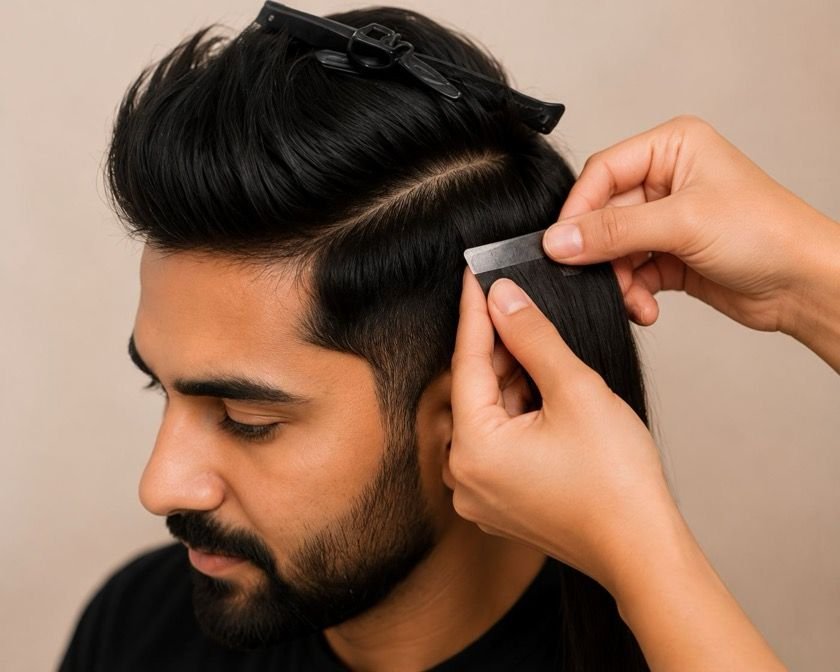
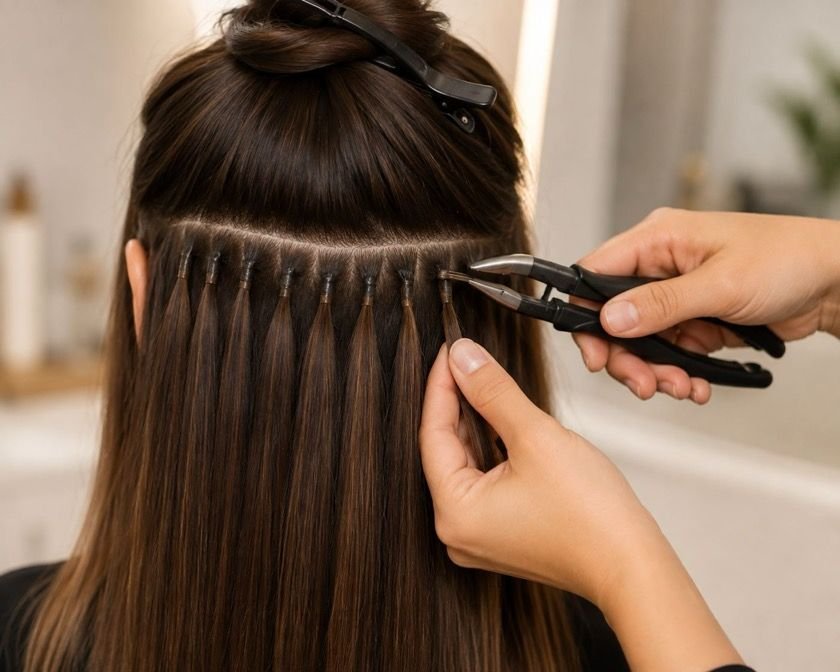
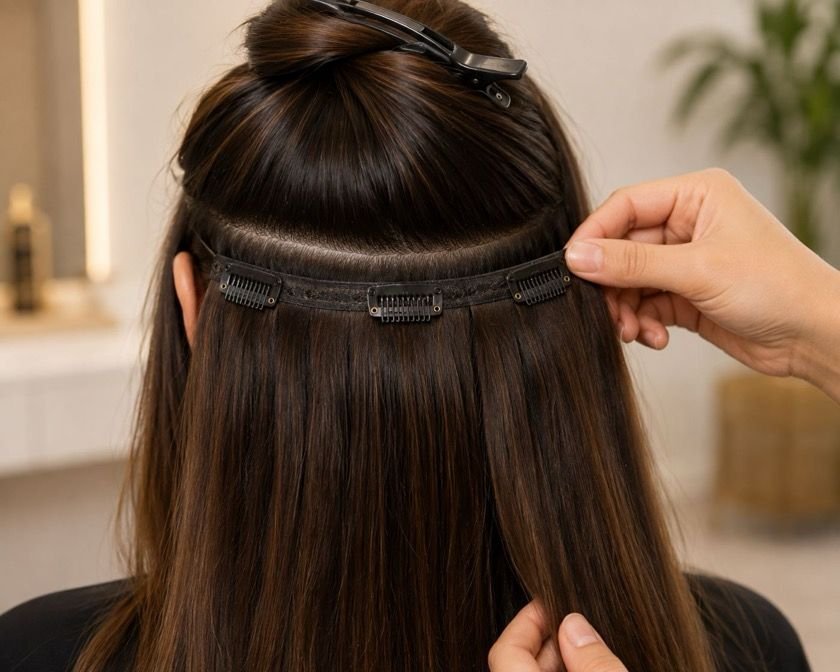
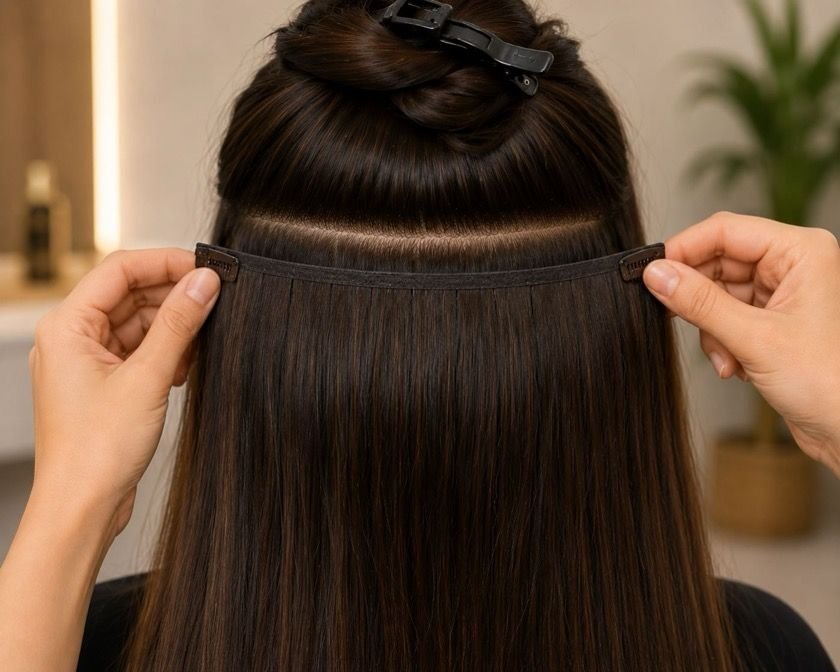

What makes the best hair extensions in Chennai
The phrase gets used loosely, so here is what actually separates a good hair extension salon in Chennai from a cheap one. Start with the hair. Genuine Remy human hair keeps its cuticle intact and running in one direction, which is why it still moves and catches light after six months. Processed non-Remy hair looks identical in the packet and turns coarse and matted after a handful of washes — and it is the single most common reason someone arrives at our studio wanting a refit far earlier than they should need one.
We are a hair extension studio rather than a general salon: three studios in Chennai — T. Nagar, Nungambakkam and Thousand Lights — where extensions, toppers and hair systems are the whole day’s work, fitted by specialists who do nothing else. That is what professional hair extensions should mean in practice: hair matched and weighed for your head by hair extension professionals in Chennai who have seen thousands of heads, not a service squeezed between a cut and a colour. It is also why the same team fits every method — you are recommended the one that suits your hair, not the one the salon happens to stock.
Then the match. Colour has to be checked in daylight rather than under salon lighting, because Indian hair carries warm undertones that tungsten bulbs flatten out. And the method should be chosen for your hair, not for the studio’s convenience: fine hair needs nano rings or lightly spaced tape, and no amount of skill makes a heavy weft safe on a thin head of hair. We will tell you when extensions are the wrong answer and point you at a topper, or at getting the shedding looked at first, instead of fitting something that will make it worse.
Finally, ask what happens after the fitting. A maintenance visit every six to eight weeks is part of the service, not an upsell — skip it and the attachment point grows away from the scalp, which is where damage actually starts. Our hair extension price list sets out what each method includes, and what moves the number. We also compare the main hair extension salons in Chennai, ours included.
Which hair extension method is right for you?
It depends on your hair type, lifestyle and how long you want to wear them. Fine hair usually suits nano rings or tape; maximum volume calls for wefts; the most natural long-term finish is keratin fusion; and for occasional wear, clip-ins win. At your free consultation we examine your hair density, scalp and daily routine, then recommend the method — and only that method — that will look best and last longest for you.
We also fit three lighter variants for hair that cannot carry the standard methods: butterfly and feather extensions, ultra-thin seamless panels with no heat or glue; and, on the strand-by-strand side, mini tip and ice glue extensions, which give the keratin fusion result with smaller bonds or no heat at all. All three are quoted at the consultation.
Which method suits your hair
| Method | Suits | Wear time | Best for | Maintenance |
|---|---|---|---|---|
| Clip-in | Any hair type | On and off daily | Occasions, zero commitment | Wash and store; nothing to move up |
| Tape-in | Fine to medium | 6–8 weeks | Volume without bulk | Moved up every 6–8 weeks |
| Weft / sew-in | Thick, strong hair | 6–8 weeks | Maximum density | Row tightened every 6–8 weeks |
| Micro / nano ring | Fine or fragile | 8–12 weeks | No heat, no glue | Rings re-clamped every 8–12 weeks |
| Keratin fusion | Strong, healthy hair | 3–6 months | The most natural movement | Removed and refitted at 3–6 months |
The right method is decided by what your hair can carry, not by preference. Fine hair takes less weight, so nano rings and sparsely placed tape suit it; thick hair can hold weft rows that would be too heavy elsewhere. We measure this at the consultation and will tell you if the method you came in asking for is the wrong one. Read more about permanent hair extensions or about extensions for thin and fine hair.
Do hair extensions look natural?
They can, and when they do not, it is almost never the method that failed. Six things decide whether a set reads as your own hair.
Colour match. Checked against your own hair in daylight, because Indian hair carries warm undertones that indoor lighting flattens out. Most sets that look obviously added were matched under a salon bulb. Density. Enough hair to look full, not so much that the extensions outweigh what is already there. Placement. Attachment points set back from the parting and the hairline, and mapped around how you actually tie your hair.
Weight. Matched to what your strands can carry, which is also the difference between a set that sits flat and one that shows. Hair quality. Remy human hair keeps moving and catching light after months; processed hair stops matching your own once the coating washes off. Blending. The cut is the last step and the one that does the most work: extensions are cut in dry, into your own hair, so there is no line where one ends and the other starts.
This is also the honest limit. A very short crop, hair that is actively shedding, or a scalp that needs attention first are cases where no method blends convincingly, and we will say so at the consultation rather than fit something that will not sit right. For an occasion where the finish has to hold through a long day, see bridal hair extensions.
100% human Remy hair
Every method above uses the same thing: 100% human hair, never a synthetic blend. We work in Remy and raw Indian hair, where every strand runs root to tip in the same direction so the cuticles lie flat. That is what stops extensions tangling and matting a few weeks in.
Cheaper hair is collected loose, stripped, then coated in silicone so it feels smooth in the shop. The coating washes out within weeks and the hair mats from the mid-lengths down. It is the single most common reason someone tells us extensions did not work for them — and it is the hair, not the method. More on how to tell good human hair from processed hair.
Hair extensions price in Chennai
Price is driven by four things, in this order: the weight of hair your head needs, the length, the grade of hair, and the method. Weight matters most — two people wanting the same look can differ twofold in grams, because one needs full coverage and the other only the back filled.
That is why nobody honest quotes a final price over the phone. The consultation is free and ends with a firm number and no obligation. See the full price guide by method.
How it works, start to finish
We look at your hair, scalp and density, and talk through what you actually want.
Matched in daylight against your own hair, not under studio lighting.
Fitted by a trained stylist, then cut and blended so it moves as one head of hair.
A washing routine that works, and a maintenance schedule that suits your method.
Good To Know
Pricing depends on the method, hair length and how much hair you need. Visit us for a free consultation and you will get an exact, no-obligation quote on the spot.
Yes — clients visit our Chennai studios from across Tamil Nadu, including Coimbatore, Madurai, Trichy and Salem. One visit is enough for a full application.
We use 100% premium human hair across every method — it washes, styles and shines exactly like your own.
It depends on the method: clip-ins are reusable for a year or more, tape and weft need refitting every 6–8 weeks, nano rings every 8–12 weeks, and keratin bonds last 3–6 months before removal.
Not when the weight suits your hair and you keep the maintenance visits. Damage almost always comes from too much hair for the strands to carry, or from leaving a set in months past due.
Usually nano rings — each ring holds very few strands, so the load is spread and there is no heat or glue. Heavy weft rows are normally the wrong call on fine hair.
Yes. Men more often need a hair system or patch than extensions, and we fit both. It is a separate, private consultation.
Clip-in fitting under an hour, tape or weft one to two hours, nano rings two to three, keratin fusion three to four. Cutting and blending is on top of that.
Free Consultation
Not sure which method? Book a free consultation and our experts will recommend the right one.
Or call us: 073057 10777Across Chennai & Tamil Nadu
At any of DA Extensionzz’s three studios, all in central Chennai and all fitting every method on this page by the same team:
- T. Nagar — 1st Floor, 55, Thirumalai Pillai Rd, Rama Kamath Puram, Chennai 600017
- Nungambakkam — JP Tower, Ground Floor, 1/1, Dr Thirumoorthy Nagar Main Road, Chennai 600034
- Thousand Lights — No 5/3, Bergamo Mall, Khader Nawaz Khan Road, Thousand Lights West, Chennai 600006
Searching for hair extensions near me in Chennai will show every kind of salon; for most of the city one of the three is a short drive, and clients from further out are booked into whichever is easier to reach. The contact page has directions and the phone number.
There is no single best method in Chennai or anywhere else — the best one for you depends on your hair’s condition and density, how much length and volume you want, your lifestyle, how much maintenance you will keep up with, and your budget. We work through those at the consultation. As a guide: nano rings suit fine or fragile hair because they spread weight and use no heat or glue. Keratin fusion gives the most natural movement on strong hair. Tape is fastest to fit and invisible in fine hair. Weft carries the most volume on thick hair. Clip-ins suit occasional wear with no commitment.
Nano rings are generally the safest, because each ring carries very few strands and nothing adhesive touches your hair. That said, safety comes down to weight and maintenance more than method: extensions fitted heavier than your hair can hold, or left in past their removal date, cause damage whichever method was used.