
Best Hair Extensions for Adding Volume
Most people who ask for extensions want thickness, not length. Their hair is long enough; it is just thin, flat, or sparse at the ends, and they want it to look like more. That is a different job from adding length, with different methods, less hair, and a lower price — and it is worth knowing that before a salon quotes you for a full head of 20-inch hair you did not ask for.
Here is how volume is done properly.
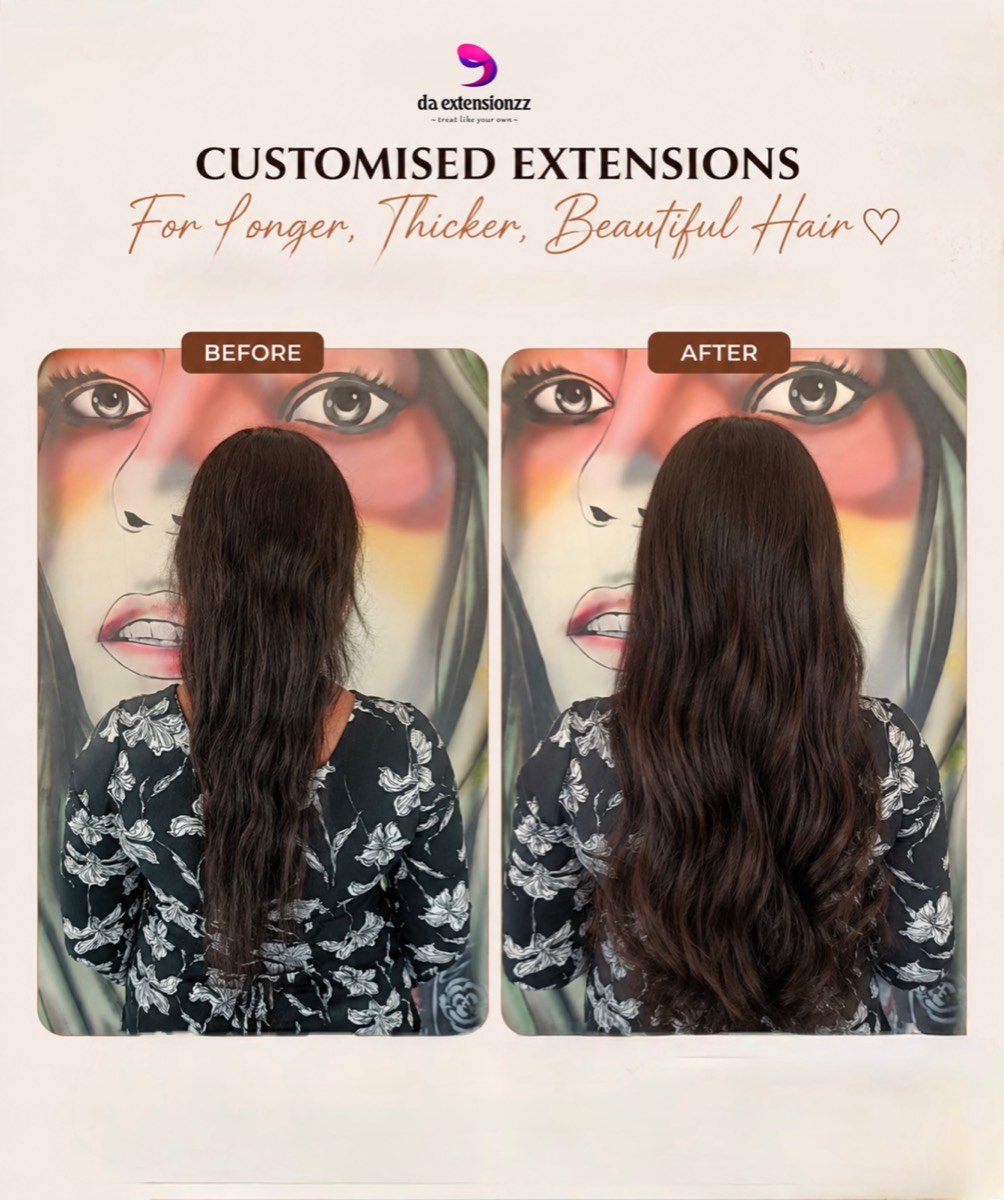
Volume is a different job from length
Length means adding hair that is longer than yours and blending the join. Volume means adding hair that is the same length as yours — sometimes a little shorter, so it sits inside your own ends rather than beyond them — and placing it where your hair is thin. The two use different amounts of hair, different placement, and often a different method.
The amount is the big difference. A full head of length often takes 150–200g. A volume job on the same head might take 50–100g, because you are filling gaps, not building out. Fewer grams is less weight on your hair and a lower price; our price list explains how weight drives the number.
Which method, by hair type
Medium to thick hair: weft
A weft is a continuous row of hair, and one row adds more thickness across the back than any number of individual strands. On hair with reasonable density it anchors securely, sits invisibly under the top layer, and gives the fullest result in a single sitting. If your hair is thick but flat, this is the method.
Fine hair: tape, lightly spaced
Tape spreads its hold across a flat panel, so fine hair carries it comfortably, and it lies flat enough not to add bulk at the root where fine hair would show it. Panels are spaced more widely and there are fewer of them, keeping the weight low. This is our most common volume fitting.
Very fine hair: nano rings
When even a tape panel might show, nano rings place individual strands exactly where they are needed with the smallest attachment there is. More work to fit; the most discreet result on hair that has little to hide with. Our guide to extensions for thin hair goes deeper.
A thin crown or parting: a topper, not extensions
Extensions add to the lengths and sides. They cannot reach the top of the head, so if the thinness you see is at the crown or along the parting, extensions will not fix it and may make the contrast worse. A hair topper sits over that area and clips in lightly, adding exactly what is missing. Many clients wear a topper for the crown and a light set of extensions for the lengths.
Occasional volume: clip-ins
For volume on a wedding day or a shoot and normal hair the rest of the time, a clip-in set cut to your own length does the job with nothing attached between wears. Needs enough of your own hair above the clips to hide them, so it suits medium hair better than very fine.
Placement: where the volume goes
Not everywhere. Volume that is added evenly across the whole head looks like a wig; volume added where the hair is actually thin looks like your hair on a good day. For most people that is the sides, where hair naturally thins, and the lower back, where the ends go sparse. The top layer of your own hair stays untouched and falls over everything. A good consultation looks at where your hair is thin before it recommends anything.
Matching the length
The extension hair should end at or just inside your own ends. Slightly shorter is often better: it supports your hair from underneath without adding a visible second layer of length. If you want a little length as well as volume, that is fine — a few centimetres blends easily — but say so, because it changes the amount of hair and the price.
What it costs
Less than length, because it uses less hair. A volume fitting often lands near the starting price for its method — tape from ₹10,000, weft from ₹12,000, nano from ₹16,000 — rather than well above it. The consultation quotes the grams before it quotes the price, and for volume the number is usually a pleasant surprise.
Frequently asked questions
Yes, and it is one of the most common fittings. The extension hair is matched to your own length and placed where your hair is thin. It uses far fewer grams than adding length, so it is lighter on your hair and less expensive.
Weft on medium-to-thick hair, for the most thickness per sitting. Tape or nano rings on fine hair, where a lighter method suits. A topper if the thinness is at the crown, which extensions cannot reach.
Usually 50–100g, against 150–200g for a full head of length. That is why volume is the less expensive job.
Yes, when they are placed where your hair is actually thin — usually the sides and lower back — and cut to sit inside your own ends. Volume added evenly everywhere is what looks artificial.
No. Extensions attach to the sides and back and cannot reach the top of the head. For a thin crown or parting a hair topper is the right tool, on its own or alongside a light set of extensions.
We look at where your hair is actually thin and quote for that, not for a full head you did not ask for. Free, about thirty minutes, at any of our three Chennai studios.
See weft extensions for volumeOr see the price list by method.